Showing posts with label Darrell D'Silva. Show all posts

Wednesday, 26 January 2011

RSC London Season 2010/11

I was lucky enough this year to be able to attend a lot of the RSC London Season and although I didn’t see them all, I think I’ve seen enough to warrant a review and evaluation of what I thought of the season as a whole, complete with some mini-awards for them as well. The shows that I saw were, in order of attending: Romeo and Juliet, Anthony and Cleopatra, The Winter’s Tale, Julius Caesar and As You Like It. By extension the ones I missed were King Lear, YP Hamlet and YP Comedy of Errors. This review will compare the content of the shows that I saw and since I missed a few will not be fully representative of the season as a whole but I will try and take the existence of the other shows into account. 
            
As good a place as any to start seems to me to be the Best Actor Award. There are really two contenders for this as both gave strong performances every time they took to the stage. These are Greg Hicks and Darrell D’Silva. Both not only played very strong characters but also interacted well with the rest of the casts they were part of. Notably, they were often paired together as two old friends and it’s a dynamic that seemed to work very well indeed, Anthony and Caesar and Leontes and Polixenes being two such examples of good relationships. Both were senior members of the company and had a lot of responsibility on their shoulders for the success or failure of each show. They were both heavily involved in a number of shows, which is remarkable given the quality of their performances in each as well as the variance and proximity of them. Going from Anthony one night to Polixenes the next must be a bit of a scare.
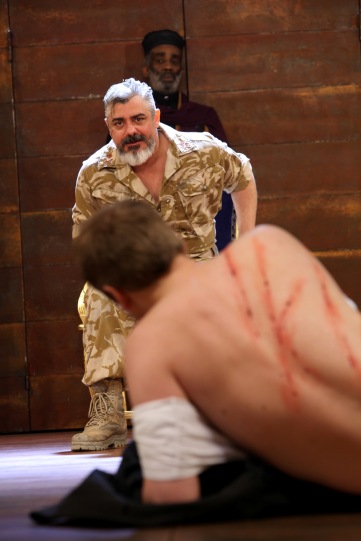
Admitting the omission of evidence from King Lear, in which they both starred (Greg Hicks as Lear and D’Silva as Kent), I am going to plump for Darrell D’Silva as the winner of this category. His performances as Anthony both in Anthony and Cleopatra and Julius Caesar were powerful and well developed. You could see how the passage of time had changed the man from one show to the next and it was a very interesting dynamic to see at work. In complete contrast, his role in The Winter’s Tale, playing Polixenes afforded him the opportunity to take up a more comedic position when dressed up in a hilarious tweed suit and hat. Again, he took it in his stride, managing to keep the latent power and authority he has on stage as well as give a light-hearted contribution to the sheep-shearing festival scenes. Greg Hicks also gave fantastic performances, giving a sterling Caesar from an almost non-existent character in the script as well as a torn and multi-faceted Leontes but, on balance, with more to do and characters with more difference between them Darrell D’Silva gave the standout contribution to the season.

Trying to find the best female performance is harder than you might think. There aren’t actually that many roles at all for the women. Portia in Julius Caesar was a minimal part, Mariah Gale made a mess of Juliet and although Kelly Hunter’s Hermione was dignified and broken, the brilliance of the performance was as short-lived as her stage time (though I still name her the worthy runner-up). Kathryn Hunter in Anthony and Cleopatra was charged as Cleopatra but felt to lack the necessary dimensions to be classed as a standout performance and Samantha Young’s Perdita in The Winter’s Tale was a role that was undoubtedly well played but small and doesn’t afford much room for expression. Going in to As You Like It, this was beginning to vex me. I was yet to see, to my mind, a performance from an actress that made me sit up and take notice of what they were doing. Thankfully, it was as if someone somewhere had heard my concerns and delivered Katy Stephens onto the stage. And thank God she arrived.

From the moment she entered the stage to the moment she closed the show with her amazing sung monologue her performance was faultless and energetic, drawing you to watch her as she darted around the stage with an apparently infinite vigour. Her transition from woman to man and back again was well done; she was able to take on the character of Ganymede without seeming too forced or at all caricature and the result was a Rosalind that we could see in moments through the Ganymede. When she was banished she was defiant and hurt but didn’t let it affect her too much and when she was young and playful it consumed her. Her on stage relationships with Mariah Gale and Jonjo O’Neill were well-suited to her and watching her dance around like a young girl with Gale before changing to assertive Ganymede in the pursuit of Orlando was marvellous. To go through a full show having to play not only one character but also that character disguised as another with so much energy and vitality was impressive enough. For her to then come on at the end and top it all off with a sung epilogue was both unexpected and the icing on the cake.

The laurels of best show are easily bestowed upon The Winter’s Tale, with Anthony and Cleopatra and As You Like It coming in as worth mentioning. The Winter’s Tale was the only show that I gave a five star rating so it’s perhaps unsurprising that I have named it the pick of the season. The title is richly deserved, though. Everything about the show was brilliant. The set was powerful and stylised, versatile and authoritative providing a suitable backdrop for both the court of Leontes at the beginning and after the collapse of the giant bookshelves to the countryside of Bohemia. The acting was also fantastic, including both of the Best Actor nominees and the runner up for Best Actress. The relationships that were brought to the stage were clear and refined at all times and at no point was the language a barrier to understanding the action (which is a major risk in badly-done Shakespeare) but was directed with intelligence and character throughout. The difference between the court of Leontes and the countryside of Bohemia was a marked difference, with the former being dark and foreboding, gloomy and claustrophobic and the latter being light and fun, music and dance were prevalent and colour was everywhere.


The humour of the second half and the disguising of Polixenes and Camillo was genuinely funny and the energy of the dancing and the youthful amour was in stark contrast to the rampant flaws that were so destructive in the first half. The appearance of the bear is also worth a mention as being a puppet made from the antique papers that made up the set. Very good indeed. I don’t think there was a bad performance in the whole show, with the younger members of the cast being handed the reins and joyfully taking them forward. Samantha Young and Tunji Kasim were well matched in Perdita and Florizell with Gruffudd Glyn giving a hilariously unaware and inept Shepherd’s Son. Brian Doherty, being tricksy and devious at every turn and keeping the audience in the know, plays Autolyclus very well. The older members of the cast are not to be left out, however. I have already mentioned Greg Hicks and Darrell D’Silva but Larrington Walker and Noma Dumezweni both deserve a mention for their contributions to the season not only here but also in the string of strong performances they gave throughout. The reveal of Hermione at the end was a showcase for the strong acting that you had come to expect by that point in the show and it was flawless.

All in all, it’s hard to criticise this show. Not because it was so well done, though I must say that it does help a great deal when a show is as well formed as this was. Beyond that consideration, however, was the basic enjoyment level of the evening. It was great fun. Simple as that. It was clear, precise, directed and intelligent but above all that, it was simply good fun.


I enjoyed the London Season a great deal. There was a lot of good theatre involved and one of my criticisms of the season as a whole is that there wasn’t enough variation. I didn’t see King Lear and I’m almost glad that I didn’t as it’s another very heavy, very hard show. The only comedy in the billing, discounting YP Comedy of Errors again because I didn’t see it, was As You Like It. It was a hilarious show, Richard Katz and Katy Stephens between them bringing laughter to an audience in rapture but I wanted more of that. It’s all very well doing lots of serious drama and tragedy but I think it needed a better balance between that and comedy. The lightheartedness of The Winter’s Tale was contrasted by the darkness in The Winter’s Tale. The comedy in As You Like It had to stand up against all the others and although I didn’t see the YP Comedy of Errors, nor did I see YP Hamlet, which I imagine would have cancelled that out as well. I think that the company available would have relished more comedy with such figures as Richard Katz et al that seem to take to it naturally. I’m not saying that the tragedies were at all bad; I thought that they were good for the most part but I don’t think the overall balance of the season was quite right.
            
I say that they were good for the most part. There were a few disappointing shows that suffered from trying too hard to be different and innovative. I would have scrapped Romeo and Juliet completely. There were some good performances in it, Forbes Masson and Richard Katz deserving mention, but it was just a very confused show. I have seen reviews that have championed it as being wonderful and brilliant but I must be honest and say that I utterly fail to see how. The natural ability of the company saved me from giving it a lower rating than three stars and I think that the lack of clarity in the show is down to the direction of Rupert Goold. Nothing seemed to fit anything else, the actors in the lead roles appeared to not fully understand their lines and have no more than two dimensions to their characters. Julius Caesar was another such flounder, with my abiding memory being of that bloody screen that overshadowed what at least could have been some very good acting on the stage. Much like Romeo and Juliet it appeared fractured and inconsistent and again I find it hard to say that anyone other than the director is as responsible as they are for making sure that doesn’t happen.
            
There was a major element of trying too hard to be different that dragged a couple of the shows down. When thy stuck to doing what the RSC do best it was brilliant. When you walk into an auditorium and see simple and powerful sets with a large central entrance on a thrust stage you know you’re at an RSC production. And you’re excited. The musicians are on the balcony and the smoke begins to rise and from Act 1 Scene I you’re caught by the drama and hooked. Powerful openings such as the massive fight sequence in Romeo and Juliet were great and the versatility of what appears at first sight to be such stark and simple sets continued to surprise. The acting was assured and confident, on the most part intelligent as well as the actors banded together in what was a very strong company. Seeing the same actors in different shows was enlightening and given how much fun it was to watch I can only imagine how much fun it was to bring it all together for a quick jaunt in London.

To my mind, the RSC is one of the most important and talented companies in the country and the 2010-11 London Season at the Roundhouse doesn’t deny that. It wasn't an outstanding season but it was very good and had a lot to offer the virgin and veteran thespians alike. Despite the few poor outings and imbalance in the overall programme it was a very strong season with some incredibly competent and talented actors. If you ever have the chance to see the RSC at work then grasp it firmly. With so much still going in Stratford-upon-Avon with the new RST complex I am already excited about what 2011 has to offer us.


Best Actor - Darrell D'Silva
Best Actress - Katy Stephens
Best Production - The Winter's Tale


John Ord (26/01/2011)

Wednesday, 12 January 2011

Julius Caesar (RSC) ***

Julius Caesar is a play filled with confrontation and ambition as powerful forces rise up against each other and fight for the control of arguably the most powerful empire in history. The play hinges on the assassination of Julius Caesar by Brutus and his accomplices.
      
Greg Hicks was a strong Caesar; his refined and considered performance giving us something to relate to in Caesar. He is a powerful man who is trapped but cannot admit to it. This is something that Hicks captures very well with what is the most developed character in the cast despite the remarkably short time he was on the stage. His scene with his wife (played well by Noma Dumezweni) is very well done and is one of the few moments of comedy in the show, which would turn out to be a welcome break. His return as the ghost in the second half is carried off well, the power in his voice being played to the full as he glides on and off.
      
Darrell D’Silva works well as Hicks’ old friend and more robust and passionate counterpart. Playing the same role as he did in Anthony and Cleopatra gave him the chance to really work on the character and having seen the latter it was enlightening to see how he was as a younger man. At one point he storms on and rushes to the back of the stage to throw up, an indication of his less strict lifestyle. His speech over Caesar’s corpse was moving and well done.
      
John Mackay suffered in a similar way to his Anthony and Cleopatra of feeling very wooden and as if he put his gestures and the like before his actual character, which was disappointing. Sam Troughton as Brutus played a tormented simple-minded man and is not the kind of person I would have expected to have been cast as Brutus. He didn’t come across as a master of battle but what he lacked in physical power he did something to make up for in emotional struggle, his argument with Portia being the standout moment (interestingly mirrored later in a similar argument with Cassius). He played a good part in the group who assassinated Caesar, being a strong if naïve leader of men but at no point did he feel powerful enough to provide Anthony with opposition of the same class. The relationship between him and Mackay’s Cassius is very well played, though their confrontation appears to lack motivation and comes from nowhere, much like the news of Portia’s death.
      
Those mentioned above and, indeed, most of the cast were capable but not much more. Nobody really made the leap from capable to memorable, the whole show being somewhat one-dimensional in character.
      
Unfortunately, the thing that I will remember most about the show will be the screen and video system that they employed to no great effect at all. Although the partitions at the back of the stage gave a good separation and the appearance of levels there was little else of any benefit. Instead of adding to the show as a whole it worked actively to the detriment of it. There’s no sense in beating around the bush here. The decidedly average videos drew attention away from the action on the stage as we tried to work out the relevance and it continued throughout until midway through the second half where they thankfully ran out of things to do and left it on generic smoke. It was a perfect example of trying to do something that was unjustified by the rest of the production and as such stood out like a sore thumb.
      
The whole production seems somewhat lackluster. What is a brutal play turned out rather one-dimensional and similar all the way through. The battles failed to excite and the rousing speeches were largely dull. The standout exception to this was the actual assassination of Caesar, which was brutal and very well done, the group diving at and around him like a pack devouring its helpless prey. The spray of blood every time the knife hit him was the most dramatic and exciting part of the play. Everything else seemed rushed and skipped and the things that were chosen to focus on appeared to have very little basis in the rest of the show, namely the opening Romulus and Remus conflict.
      
The set barely existed as they kept it bare and it was almost as bland as the costumes in the first half, the second half efforts being only marginally better.
      
So, in summation of all of these positive and negative points what do I have to say about the show? Avocadoes. That is what I have to say about it. You may at this point be forgiven for not knowing what I mean so I shall explain. Avocadoes are a food that I cannot work out whether or not I like. When presented with one I will have more and more and yet still remain undecided at the end as to whether or not I liked it. Many times I have had avocadoes and I still cannot decided whether or not I like them. It puzzles me greatly. This is an avocado play. I just can’t decide whether I liked it or not.  It left me unsatisfied and puzzling over what was going on.
      
On balance, the show was decidedly average. It’s not likely to stimulate much excitement or intellectual development but there are a few moments that make it worth seeing. Greg Hicks and Darrell D’Silva are the stars of the show, even if the firmament is dim at best and their efforts are worth seeing.


Written by William Shakespeare; Directed by Lucy Bailey; at the Roundhouse Theatre; Starring Darrell D'Silva, Greg Hicks, John Mackay, Sam Troughton, Brian Doherty, Hannah Young, Noma Dumezweni; Runs from 06 January 2011 - 05 March 2011 as part of the RSC London Season.


John Ord (10/01/11)

Friday, 17 December 2010

The Winter's Tale (RSC) *****


The Winter’s Tale is one of the last plays that Shakespeare wrote and many people see echoes of his own life in the story. The premature death of a son and the reunification of love and family against all odds seem to speak from a place close to the Bard’s heart. Be this as it may, it is all conjecture and as such becomes only one layer of what is a heavily nuanced play. The balance between reality and fairy tale is played to the limit and the trials of the characters are swift and severe for the most part. The play tries to balance various opposites with each other, giving the show a character unlike his other work. This RSC production captures a perfect balance between these various aspects of what is an enchanting whole.
      
The set design is simple but tremendously effective and warrants first mention. From the opening there are two large bookshelves lined with books that dominate the stage, elaborately filled by a dining table. When Leontes’ world comes crashing down around him, so do the bookshelves in a spectacular and unexpected moment that sees the whole stage change character in one brutal movement. The world becomes full of torn paper and books that act as scenery, grass, leaves on the imaginative trees and even costumes for a dance at the fayre and a puppet for the infamous pursuing bear. The puppet must reach about ten feet high and is marvellous piece of work. The artistic design of this torn paper look is surprisingly well suited to the play, helping it achieve the delicate balance between fairy tale and reality. A fantastically well used effect.
      
The actors take on the gauntlet thrown by the remarkable set and artistic design, carrying the torch with remarkable energy. Foremost among these is Greg Hicks, who is tormented almost from the first instant he appears on stage. The swift and dramatic descent of Leontes is one that can be hard to place without making it full of aimless shouting and general ire. Hicks manages to balance the desire to be rational and the inability to do so in what is a puzzlingly moving performance in the first half. His jealous rage flashes and fires in a powerful and directed way, bringing a reality to the show that is much needed. His performance is powerful, giving the authority that Leontes holds a feel of danger. You feel like you don’t know what he’ll do next even if you know the play. He single-handedly anchors the show in the serious and traumatic.
      
In contrast, Larrington Walker does everything he can to counter this. From the moment he walks on with his walking stick to the moment he leaves dressed up in his new gentlemanly suit he is a perpetual source of comic charm, bringing a lighthearted energy and wit that belies his age. He gifts us with what I would call a youthful performance and one that is a wonderful yin to Greg Hicks’ yan.
      
Noma Dumezweni also deserves a mention for the assured way in which she brings Paulina to the stage. Her character has the unenviable task of confronting the male powerhouses of the story and she does so with an authority that draws you to her. She is tasked with treading the tightrope between the real and the imagined when she has to bring Hermione back to life at the end and she does so with a wonderfully natural talent.
      
The supporting cast were in typically tremendous RSC form, their performances all standing up to the rigour of critique. Samantha Young, Tunji Kasim and Kelly Hunter all deserve a mention for their energetic and emotive contributions. The younger couple making the earlier sheep-shearing fayre a thoroughly enjoyable and ceaselessly entertaining period before the unification at the end plucks at your heartstrings in its magically melancholy way. The beginning of the second half with the introduction of Autolycus and the fayre is a marvelously energetic opposite to the first half, the dancing and costume making a previously dark scene lighten and gives a stage for the youth and magic of childhood and adolescence to fight against the pain of regret and mistakes that the older characters feel. Darrell D’Silva and John Mackay struck up a wonderful partnership as Polixenes and Camillo especially when they appear disguised in their tweed suits and bumbling mannerisms. A wonderful demonstration of ensemble work.
      
The music is an important aspect of the story and is a just as important cog of this production, the musicians both onstage and offstage add colour to the show and along with a very dramatic and sometimes harrowing echo effect it gave the show an added dimension that is hard to achieve, especially with Shakespeare. A similarly enjoyable achievement of the show is the humour that the cast bring out of the show. Understanding the language perfectly and bringing it out in a vivid array of colours and sounds brought laughs and good humour that broke up the harsh torment that takes center stage.
      
The unity of this production is remarkable. It navigates a demanding script with an effortless ease that holds the various facets of the show in a wonderful balance. This is as fine a Shakespeare show as you could wish for: entertaining and provocative, funny and dark, harsh and imaginative. A magnificent show.


Written by William Shakespeare; Directed by David Farr; at the Roundhouse Theatre; starring Darrell D'Silva, Noma Dumezweni, Greg Hicks, Kelly Hunter, John Mackay, Larrington Walker, Brian Doherty, Gruffudd Glyn, Tunji Kasim, Samantha Young; Runs from 14 December 2010 - 01 January 2011 as part of the RSC London Season.


John Ord (16/12/2010)

Monday, 13 December 2010

Antony and Cleopatra (RSC) ****

Antony and Cleopatra is not a show I knew a great deal about going in, which is annoying to admit. The show, I’m glad to say, has remedied this wonderfully. The show is clear all the way through and at no point did I feel out of depth or lost with the language, which is a supreme compliment for anyone attempting to stage Shakespeare. Compliments seem to flow naturally for this show, which is a masterful excursion into the realm of Shakespearean drama. From the off the atmosphere is one of high drama, the auditorium filled with smoke, which continues intermittently throughout. The story is one that involved very powerful characters that have great authority and charisma, true leaders of men in a golden age of war and conquest. The show details the fall from grace of perhaps the greatest of these men and as such requires a production that is equally strong and physical. It delivers fantastically.
      
The set was typically RSC and was well done, a rusty wall at the back giving both a fitting backdrop and an innovative system of entrances and exits, the style similar to that of the Romeo and Juliet. The general image of the show was something I liked. It was in perfect keeping with the themes and the story, giving the action a very grounded and real feeling.
      
Darrell D’Silva’s efforts of Antony were unfalteringly majestic throughout. He owned the stage whenever he was present and delivered what was a powerful performance. I thoroughly enjoyed every aspect of his character; from his beard (definitely worth a mention!) to the depth he had, effortlessly and dramatically bringing Antony to life. He was as a lion, owning the stage in the confidence that it is rightfully his and when challenged, thrashing and lashing out with a violence that was, at times, terrifying and at all times majestic to behold.
      
When I first saw Kathryn Hunter enter the stage as Cleopatra she didn’t wholly convince me. This, however, proved to be a good demonstration of the old adage ‘don’t judge a book by its cover’ as she grew into the role as the drama unfolded, conveying the conflict of her tortured love for Anthony and her pride as the legendary Queen of Egypt with a distraught agony that was violently emotional. Her efforts with her numerous costume changes deserve a mention, as well as her ability to act out the more dramatic scenes powerfully, though her overall performance could have done with more colour.
      
The performance that stood out for me other than Darrell D’Silva was Brian Doherty as Enobarbus. As one of the supporting cast he made a decent bid for a lead role. He was mature and well rounded and his journey was one that you found yourself eager to follow and his end came as a genuinely upsetting moment in the play. He found the character of a battle-hardened soldier who has become disenchanted with life very well, putting his store in his captain above all else. A very strong performance.
      
Other cast members were generally strong in their roles, notably Katy Stephens, Larrington Walker and Clarence Smith. Adam Burton’s Scarus grew from a role that was very much incidental character in the first act to someone who found himself at the center of the action and along with Katy Stephens gave a very emotional portrayal of two strong fighters who are faced with their cause falling down around them. I rate these two (and Brain Doherty) very highly indeed.
      
John Mackay (Caesar) was, however, a bit poor. I found myself struggling with his character and his apparent inconsistency between merciful and brutal. He could have found a better path through the character as he came across confused and inconsistent, which was a disappointment as he was meant to be the challenge to such a strong Antony as Darrell D’Silva.
      
One of the few things that didn’t work in the show is the costume. Any attempt to make a modern dress production of Shakespeare runs a gauntlet of risks and although Antony and Cleopatra makes a valiant effort and largely succeeds there are a few moments where it falls down. Cleopatra has a myriad of amazing costumes throughout but they seem confused at times with the conflict between the archaic language and modern dress not being fully resolved. The decision to put Caesar and a few others in suits as opposed to military gear like the rest of the cast is odd and felt a bit out of place. I would say, however, that it was a largely very successful attempt at modern dress period drama.
      
I also wasn’t a fan of the way in which they portrayed the sea battle but I recognise that it’s a difficult thing to do and have no qualms about them doing it in that way.
      
This is a show that it would be a shame to miss. This is the RSC doing what they do best and doing it well. Apart from the pitfalls that it is incredibly difficult to avoid with Shakespeare it is a generally very able cast giving a very good account of themselves, led from the front by Darrell D’Silva, who gives a truly inspiring performance. I thoroughly enjoyed the show and would recommend it for anyone wanting to see something majestic on stage.


Written by William Shakespeare; Directed by Michael Boyd; at the Roundhouse Theatre; Starring Darrell D'Silva, Kathryn Hunter, Brian Doherty, Adam Burton, Katy Stephens, John Mackay, Greg Hicks, Larrington Walker; Runs from 08 December 2010 - 30 December 2010 as part of the RSC London Season.


John Ord (08/12/2010)