Thursday, 7 July 2011

Being Shakespeare ****


It is probably best that I dispel now any confusion by saying that this is not, in fact, two hours of Simon Callow being Shakespeare. It is a narrative in which Callow explains what we know and can reasonably suppose about the mysterious life of Mr. William Shakespeare of Stratford-upon-Avon from his humble beginnings in the backwater Warwickshire town to his living the high-life as one of London’s elite, popular among both the nobles of the court and the commoners of the street.

The narrative itself is expertly woven from birth to death by Jonathan Bate, following the seven stages of man that Shakespeare himself outlined in As You Like It, so that it gives a solid and easy to understand pattern to the story. It is a magnificent script, delving into the history of the man himself with such startling clarity that it feels authoritative, mixing the fact and supposition about the unknown years of his life with snippits and gobbits from his work. When opening the second act, for example, a rendition of the famous Henry V speech ‘once more unto the breach’ leads not only into the second act but the fourth age, the soldier, as well.
      
The ease with which Bate weaves the words of Shakespeare into the story of his life is truly remarkable and seems effortless. Bate himself is, unsurprisingly, a Shakespeare scholar, having written a number of books on the swan of Avon and been the chief editor for the RSC edition of the Complete Works of William Shakespeare. He has the background, then, to make this seem natural and working with genius such as that of Shakespeare one can feasibly imagine the hardest part being the choice of what to draw upon and include. The various events that plagued Shakespeare himself, such as the black death, were given due significance as this show achieved something that I have not seen before in any explanation of the bard’s life. It pieced together events in his life and the work he was producing and made an educated guess as to how he would have felt, what motivated him to change his style or why he chose to write about war and honour. It made Shakespeare a person as opposed to a historical figure for study.
      
The main contributory factor to the personal nature of the show itself was not the script, but the actor at the centre of it all. Simon Callow pulled off what is an extraordinary performance as the shifting voice on stage, moving seamlessly from narrator to character no matter what the scene would be. His performances as all the characters from Bottom to Juliet are engaging and many are powerfully emotive as just as many are funny and light-hearted.
      
Humour is a large part of the show. There is a large amount of densely packed information delivered at once at many points throughout and Callow is able to offset this marvelously with some well-timed jokes about life way back when and life now and how the two compare. Having lived in Stratford-upon-Avon myself for a period I can say that from what Callow was telling us of Shakespeare’s day it hasn’t changed all that much! The sheer number of characters that Callow portrays is staggering, and all are brilliantly constructed in their fine simplicity.
      
Callow’s delivery is near-faultless. There were a few line stumbles but all of which were rapidly corrected and bearing in mind that the entire show is him talking for two hours (and it is a very wordy script, then dotted with bits of Shakespeare) I think the occasional line slip is forgivable. His mastery of the language, the script and his wonderful ability to shift both slowly and suddenly between moods and perspectives makes it far more entertaining than many would believe it has a right to be. I can’t imagine anyone else doing a better job than Callow has done here, bringing Shakespeare to life without ever being Shakespeare.
      
I particularly liked the inclusion of the reality of fairies and goblins for children growing up in the countryside and the mystery of the now dispatched forest of Arden. It gave not only a childish beginning that instantly and obviously captivated the imagination of the entire audience but it gave a wonderfully imaginative place to return to, much as Shakespeare himself did, at the end.

      
Imagination was also a huge aspect of the set. Simple and enchanting in its own way it sported very little by way of anything much. There were a couple of trees, some chairs, books, a globe, a sword and a couple of dramatic holes in the floor and walls that threw out light and flames when bidden to do so. It was simple but wonderfully effective. With the addition of plain and brief sound effects, such as a beating drum during a Henry V speech and some subtly maneuvered lighting changes the stage itself appeared to have a character akin to the man himself, transforming when bidden from Lear to Prospero amid others.
      
The show itself is a masterclass in simplicity and good acting, the result being a show that is both absorbing and entertaining, completely immersing you in the world and the mind of Shakespeare, which is exhilarating in itself never mind that it’s Simon Callow on stage proving his credentials once again. If you have even a passing interest in Shakespeare (which I would argue everyone should, but then, I’m biased) this is simply unmissable. If you don’t have an interest in Shakespeare, this will garner one. Simple and simply unmissable.


Written by Jonathan Bate; Directed by Tom Cairns; At Trafalgar Studios, Studio 1; Starring Simon Callow; Runs from 15 June 11 - 23 July 11.


John Ord (05/07/2011)

Friday, 1 July 2011

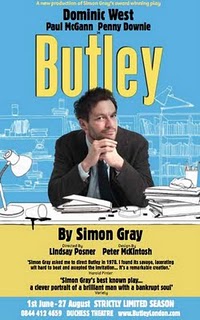
Butley ****


Butley is a play very much written from an insider’s point of view. Simon Gray was himself a lecturer of English and Queen Mary College, London as well as being a heavy smoker, drinker and in possession of a deadly array of words and witticisms. Ben Butley is also all of the above (university unspecified however) and although the autobiographical nature of the play was only confirmed to be ‘up to a point’ the similarity in the characters of the author and the lead makes for an intriguing study of what is an undeniably awful day in the life of Ben Butley. The realism of the character and the situation really strikes very close to home.
      
The homoerotic undertones of the piece are played incredibly well by the cast and you can feel the echo of Gray’s own experiences in the voices of the characters and of course the words they use. Gray himself had developed many close friendships with men over the course of his life but he wasn’t gay, though he was amused by the question and certainly loved the company of men. Butley is of a similar ilk as well, his friendship with his colleague and protégé Joseph being as close to a married life as one is likely to achieve without actually being married, a relationship made even more tense by Joseph’s homosexuality.
      
On this count and on many others Dominic West is in inspirational form, bounding around the stage with the energy of an antelope that’s been caught by a lion and is furiously lashing out in every way it can before it is brought down. People often talk of a ball and the importance of not letting it drop and if there is any performance on the West End at the moment that exemplifies this it is Dominic West’s here. He has clearly put a great deal of effort into creating the character of Ben Butley and reaps the rewards of his endeavours. The realism of the character and the ease with which he speaks the lines is remarkable, with every line, no matter how quick or witty, having a clear point of inception and purpose. There is an awful lot of hectic, chaotic madness but at every point you are aware that there is method in it. The many moments of madness are imbued with such energy that they never cease to be anything other than hilarious, further boosted by West’s talent for comedy. There are also a few moments of sudden transition from humour to seriousness and West handles them well, instantly changing the atmosphere in the room and engaging the audience.
      
He is also a very generous performer, allowing his fellow cast members their moments and giving them as much opportunity as he can, which is a dynamic that works especially well with Martin Hutson’s Joseph. Hutson gives a nervous energy to the show that plays very well with the frantic nature of Butley himself. The relationship between the two is a varied one, with moments of closeness and moments of friction interwoven in a strikingly natural and true-to-life fashion. Hutson himself also gives what is a very strong performance as the younger man desperately trying to find a way to remove himself from his relationship with Butley, his characterisation being second only to West in the show.

The other performance that really stood out for me was from Penny Downie who played Edna Shaft, another lecturer in the university English department that has been struggling with her own issues, such as an unfinished book of literary criticism and a tediously deviant student. Her performance added an air of mystery to the show as she and Butley talk and act as if they have a great deal of history but neither ever mentions explicitly what this history is. Inasmuch as Butley pushes away everyone he cares about, including his students, West and Downie certainly add a powerfully subtle dynamic between the two characters that adds a further layer to what is already an impressive script. The phone calls from the perpetually elusive Dean and the constant interruptions from Downie place Butley and Joe in a wider picture that is well illustrated by Downie’s strong showing.

      
The set design was something else that I thoroughly enjoyed with the difference between the stark left-hand side of the stage that corresponded to Joe and the cluttered and overflowing right-hand side that was clearly Butley’s domain. Lots of the physical gags were very good as well and were only able to be so because of Peter McKintosh’s apt setting.
      
The small size of the roles of the students serve to demonstrate Butley’s prowess in avoiding student contact but they are strong as well, particularly Emma Hiddleston as the keen student who wants her essays read so that she may find her way into teaching herself, suitably put down by Butley, saying that A-Level teachers are like firemen called out to quench a fire long since out.
      
All in all, I think this show was incredibly good fun above all else and a showcase of fantastic talent, particularly from Dominic West as he is allowed to indulge himself in a comedy role, taking to it like someone with prader-willi syndrome to cake and it is delightful to watch. I’d thoroughly recommend giving it a go, especially if you have a prior connection to either university, lecturers, teachers or English.


Written by Simon Gray; Directed by Lindsay Posner; At the Duchess Theatre; Starring Dominic West, Paul McGann, Penny Downie, Amanda Drew, Martin Hutson, Emma Hiddleston, Cal Brigden; Runs from 06 June 11 - 27 August 11.


http://www.butleylondon.com/?gclid=CPTpobi34KkCFUwc4QoduUhSYA


John Ord (28/06/2011)

Saturday, 18 June 2011

Pygmalion ****


The Greek myth of Pygmalion has had many interpretations in modern culture, not least in My Fair Lady and this, the show it was based on, George Bernard Shaw’s incarnation. Following the story of Henry Higgins (Rupert Everett) in his greatest exploit as a phoneticist in training a flower-seller Cockney he met in Covent Garden to pass as a duchess at an ambassador’s garden party. The story, which you know going in from the title, is that Henry Higgins falls in love with his project, Miss Eliza Doolittle and the climax is whether or not they can reconcile their differences and admit their feelings to each other.
      
Having the designer and director being the same person, Philip Prowse, worked well for the show, as the transitions between the sets worked very well indeed being very slick and making a good use of lighting in the processes. The back wall that breaks in the middle to reveal a different stage shape is well used and supports the overall image of the show very well as one that is slick and refined, just as the language and use of vocabulary is in the script. All in all it was a good job from Philip Prowse.
      
It’s a good job well done by most of the cast as well, most notably Kara Tointon as Eliza Doolittle. The progression of Eliza from Cockney flower girl to refined duchess allowed Tointon to explore a number of different personas with the same character and she grasps this opportunity with both hands. The script invites the part to be a caricature of the personas, illustrating the differences between them and the progression from a to b and Tointon holds nothing back. From her first introduction to her final exit she is compelling and hilarious in her part, blustering round the stage like an angered wasp at the start and stalking around it like a proud aristocat at the end. Considering that this was her West End debut, I am excited about her future prospects stalking the boards here in London (and not just on EastEnders).
      

Rupert Everett is one of the main draws of this show and rightly so. From the very beginning his character wields a latent authority that he capitalises on throughout, commanding the stage with a forceful, devil-may-care attitude. Everett plays Higgins as a dark and brooding man, someone who cares little for social convention, or at the very least fails to see how his behavior doesn’t comply with it and he fits the role perfectly. His relationship on stage with Tointon is simply fun to watch. Both are larger than life characters and watching them clash is entertaining and his railing against improper use of language and speech is entertaining to those who have similar gripes.
      
Two supporting cast members stand out from the rest and they are Michael Feast and Peter Eyre. Feast plays the father of Eliza Doolittle, who marches in and argues against being drawn into the devious middle-class morality that threatens him, a fair and less-than-honest working-class man. Again something of a caricature he adds a dynamism to the proceedings that is purely comical and different to the relationship between Henry and Eliza. Peter Eyre plays the colleague of Higgins in his field of phonetics, Colonel Pickering and he is himself the exact opposite of Higgins. Where Higgins is dark and brooding, contrary to convention, Pickering is light and noble, exemplifying the manners and ‘good solid upbringing’ of the upper classes as Shaw portrays them. Eyre’s contributions act as a wonderful contradiction to Everett and they work together very well on stage. Eyre adds a sort of unspoken and unacknowledged gentility to the stage that is necessary in the development of Tointon’s character.
      
Roberta Taylor plays a strong part in the action as well as Higgins’ housekeeper Mrs Pearce who has the unenviable job of having to clean up after him and keep track of his life for him. She exerts an authority of her own, particularly over Higgins, that is well-embodied on stage by Taylor and Everett together. The whole supporting cast do very fine jobs indeed, but they are clearly merely there to highlight the dynamics between the leads as opposed to adding to the play itself, with the exception of Alfred Doolittle and Colonel Pickering.
      

The story itself is very short and I think this is harmful to the show as the major drawback. The plot is uneventful and since you know going in what the basic storyline will be it falls on how the inevitable conclusion comes to pass to stand up as the justification of the play. I’m not sure it succeeds. The relationships are well developed in the script but I don’t think the situation and progression is explored fully enough by a long way, instead being something of a whistle-stop tour through the six months that the play covers and since there is no intrigue surrounding the plot, this isn’t enough to justify the play in my mind. This is compounded by the brevity of the show that leaves plenty of unused time to develop this missing element that has simply not been taken.
     
The cast and crew do a very good job with a script that could have done a lot more to help them, leading me to give it a good review. However, for the ticket prices they are charging and the length of the show I wouldn’t recommend you go and see it unless you are already a fan of Tointon, Everett, Shaw or Pygmalion itself. 


Written by George Bernard Shaw; Directed by Philip Prowse; At the Garrick Theatre; Starring Kara Tointon, Rupert Everett, Diana Rigg, Michael Feast, Peter Eyre, Roberta Taylor; Runs from 12 May 11 - 03 September 11.


John Ord (15/06/2011)