Friday, 26 August 2011

The Rise and Fall of Little Voice ***


Little Voice is different. Living with her widowed mother the only place she finds any solace is in her records, left to her by her father. She locks herself away in her room and is a quiet, reclusive girl, preferring to be kept apart from her mother and her various and numerous gentlemen callers. The most recent of these is Ray Say, an impresario for the local entertainment circuit who overhears Little Voice singing in her room and smells success, but first he must find a way to convince this shy creature to take to the stage. The story of her often traumatic journey is full of moments that could make your heart stand up and openly weep or dance on cue.
      
The cast has promise in it; Helen Sheals plays Little Voice’s mother in this production but was cast as LV herself in the premiere at the Bristol Old Vic in 1993. Lauren Hood, who plays Little Voice herself, graduated from Mountview in 2008 and has been nominated for numerous awards since; a real up-and-coming star of the theatrical firmament. Unfortunately, she is the only bright light in the show, which is unfortunate not least because one of the characters is a lighting technician.
      
Helen Sheals fell victim to a number of line slips that were the beginning of the slope that continued to decline for two hours. There was little variation in her tone, no tenderness in her, no depth of character or nuance to give her more humanity than the caricatured role of ‘drunk and selfish mother’. I would have expected a more nuanced performance from someone who knows the script as intimately as she should but she cannot take sole responsibility for it.
      
Neil McCaul as Ray was good; he had a latent bravado that brought some energy to the stage bringing with it a solidity and a firmness both in his character and his performance. When he was on stage there was a clear direction to the action and some of his conversations with LV were deeply moving, he was even funny from time to time.
     
Despite this, Lauren Hood was undoubtedly the centerpiece holding the show together. She had a much deeper level of character than the others and the musical showcase that the play afforded her had my hair standing on end, each competing for the best possible view. Whether she was quietly clinging to her necklace or boldly singing on stage she was both believable and watchable, giving a commendable performance. Watch this space.
       
Lisa Riley isn’t given much of a chance to shine as Sadie, which was a bit of a missed opportunity, apart from the loosely choreographed dance scene that might have sent Michael Jackson to the grave if he hadn’t already paid it a visit or two. I joke; it wasn’t that bad but as with much of the show I couldn’t discern whether or not it was meant to be bad. A few of the jokes are obviously intended to be bad jokes but not all of them, I hope, and a few of the moments dotted around seem to be similarly perplexing. I point the finger of misdirection at, guess who, the director. Suspiciously sharing a surname with the painfully underwhelming Jack Chissick she has failed to bring the performance out of the woodwork that may be waiting there. It felt like a dress rehearsal with little confidence in the action, movement or lines and very little depth and nuance to the characters.
      
The set deserves a mention, it was very good; the upstairs downstairs separation of LV’s bedroom and the living room worked very well and the ease with which the set transformed from the house to the club was simple and effective. Technically, however, there were a fair few rough edges. Hood had a microphone on her cheek but Jack Chissick was given an unnecessary freestanding mic that he shouted into, battering the audience with consonants, which was especially annoying after the constant feedback from the speakers. There was also a poorly disguised smoke machine and a Rubik’s Cube that was frustratingly out of place. But I’m nitpicking now.
      
The script was puzzling at best, the title implying that the piece is a tragedy but the finale being ambiguous enough to leave us without a satisfying ending and a lot of imagery that could have been used to much greater effect and poignancy (particularly surrounding the regrettably bitty part of Billy, the man with a passion for lights). The title also implies that the story is about LV, but one would be mistaken to believe that to be the case as it focuses more on her overbearing mother and completely skips the stories you’d want to see, for example how Ray convinced and trained LV to give the performance she did. There is definitely a story in there but I’m not entirely sure how it was nominated for so many awards when it opened; it feels more like a draft than a finished play.
      
Having said all this rather negative stuff, it’s not actually a bad night. Hood’s medley in the second act saves the show from the doldrums and gives it all a bit of sparkle, which is sorely needed. Although it’s not worth traipsing round the country for, it’s not the worst thing in the world to be subjected to for a couple of hours. Thank Lauren Hood for that.


Written by Jim Cartwright; Directed by Hannah Chissick; At the Oxford Playhouse; Starring Lauren Hood, Helen Sheals, Lisa Riley, Philip Hill-Pearson, Neil McCaul, Jack Chissick; Runs from 29 July 11 - 20 August 11 (tour).


John Ord (23/08/2011)

Tuesday, 26 July 2011

Richard III ****


The final installment of one of Shakespeare’s tetralogies, following Henry VI Parts 1 -3, the play tells the story of the rise of Richard III and his immediate decline at Bosworth Field. It is a particularly striking story, marking the end of the Wars of the Roses and placing Richard in a particularly interesting position. Shakespeare gives us a character that is the classic anti-hero. Everything he does is malicious, selfish and Machiavellian, his behavior the exact opposite of the classical hero, yet he is the main character in the play, the focus, the lead. Shakespeare invested a lot of time into making this dynamic work, this being his longest play of all bar only Hamlet, which results in a character that is charming and seductive as well as bitter and evil. It is a delight to watch from beginning to end whether you are aware of the constantly referenced Henry VI plays or not.
      
The design of a Shakespeare play is always crucial. Mendes has opted for modern dress and has imitated the uniform of various dictatorships in our modern world, giving it that necessary modern feel. The design of the set was marvellous from start to finish. The greyness wasn’t overbearing and the doors that surrounded the stage gave enough options for the action to be constantly dynamic. When the stage opened back at the interval the shape changed and gave a feeling of unification and direction; that there was now only one way the action was going and it was surprisingly powerful.
      
There is a lot of technology involved in the show and, by and large, it was all very good indeed. The scene where Richard is offered the crown over a video link was both funny and disturbing, much like Richard himself. The titles splashed across the stage at each scene change helped give the show direction and I approved of them but there was a bit too much technology. The use of microphones and supplemented cheering from crowds was fantastic and really gave a sense of drama but this wasn’t the case for all innovations. The power of good old-fashioned drums was proven in this production; when there were only a few drums they felt powerful, when everyone was on stage with one and making a lot of noise it was truly imposing.
      
One of the famous Shakespearean roles, Richard III is taken easily in his stride by Kevin Spacey, clearly wanting to give a different take on the role to the successes of the past. His dictator is very panto in his characterization; the contraption that straps his leg together and his walk as a result of it are very Hunchback of Notre Dame and his mannerisms and swift flips between smiling façade and sinister plotting are sudden and comical – it is a very funny Richard that Spacey gives us – and the result is that you enjoy his time on stage, you enjoy him and his plans and even though you know he must be defeated and that it is good that he is defeated you do mourn his passing. Spacey’s Richard is enjoying his life, he is enjoying killing people left right and center, he is enjoying scheming and deceiving his friends and the people as if it were a glorified game to him. This makes him all the more human and watchable. Spacey never once makes a mistake, a wrong line, a faulty step or anything and his Richard is confident and assured as a result, making him as terrifying as he is pantomime.
      
There is not a weak link in the cast but there are too many of them to compliment name by name so I shall settle for picking out Chuck Iwuji as a special mention. Other than Spacey’s Richard, his Buckingham was the character that stood out the most and this was all due to Iwuji’s dauntless efforts. Whether scheming in a shady room or on the television asking Richard to be King of England he is confident and subtle, a perfect performance. You often see Shakespeare on stage and lose the meaning of the lines because the actors themselves aren’t entirely sure what they’re saying. Iwuji clearly understood every word and his brilliant delivery ensured that we did as well: a rival for Kevin Spacey as the leading member of the cast in my opinion.
      

There is the undeniable feel of Sam Mendes about this production, again proving in his Bridge Project with the Old Vic that American and English actors can mix and do Shakespeare well he is developing a new style of transatlantic theatre.
      
It was not, however, a perfect show (although this may now be classed as nitpicking). The decision to have the two young princes in the tower played by women made no sense at all. There was no need for it and it only served to break the rhythm, suddenly making you very aware that you were in a theatre watching a play as opposed to being engrossed in the action. The only major criticism is of the character of Margaret. It wasn’t clear what exactly she was, whether she was a ghost or a witch or an old bitter Queen. She wasn’t incorporated well into the current action of the play and from her first appearance I wasn’t entirely sure of her context or form.
      
This show is one of the best I have seen in recent months, which is perhaps unsurprising for the Old Vic, thriving under the Artistic Direction of Kevin Spacey. As Shakespeare goes, this goes very well indeed, succeeding in almost every facet. It would be regrettable indeed to miss it.


Written by William Shakespeare; Directed by Sam Mendes; At the Old Vic; Starring Kevin Spacey, Chuk Iwuji, Jack Ellis, Gary Powell, Andrew Long, Michael Rudko, Annabel Scholey, Haydyn Gwynne; Runs from18 June 11 - 11 September 11.


John Ord (19/07/2011)

Sunday, 17 July 2011

Rosencrantz and Guildenstern Are Dead ***

Trevor Nunn was due to direct the premiere of Tom Stoppard’s breakthrough play way back in 1965 as the opening show of an RSC season of new theatre in London. 46 years later he has his chance to correct the pitfalls of fate and give it a go as part of the Trevor Nunn Season at the Haymarket, which opened with Flare Path and is set to close with The Tempest. Nunn is very familiar with Stoppard’s other work as well, having directed his masterpiece, Arcadia, at the National in ’96 and this marriage looks, at least on paper, to be made in heaven.

The main theme of the play is not so divine, at least not explicitly. Stoppard’s brilliant script is, however, and dashes between the intelligent rhythmic wordplay that has become a signature of his style and philosophical musings on meaning, probability, chaos and most importantly, death, being just as hilarious as it is deflating. Drawn from the inspired suggestion from his agent at the time, Kenneth Ewing, that he write a play about Shakespeare’s ignominious duo from Hamlet, Rosencrantz and Guildenstern, Stoppard proceeded to re-invent the courtiers as a Beckettian double-act and recreate the story of Hamlet from their perspective as a series of events much akin to Beckett’s Waiting for Godot. Rosencrantz and Guildenstern spend much of the play musing over similar concepts to what you imagine a younger Vladimir and Estragon would and in a wonderfully energetic fashion from the tossing of coins to the game of questions, both of which are well staged here.
      
Death is the central theme not only in Stoppard’s text, but also in Waiting for Godot and Hamlet, giving a strong point of synthesis between the two and at no point in the production does Nunn let you forget the title; as the bewildered courtiers scrabble around on stage desperately trying to find meaning and some certainty you, sitting in the audience, are aware, painfully at times, that Rosencrantz and Guildenstern are dead.

This similarity is where Nunn chooses to style the play, opening with the courtiers alone and entertaining themselves by a leafless tree. The play continues in this melancholy fashion for distraction until the arrival of the Player and his troupe, eerily reminiscent of Pozzo and the very un-Lucky, at which point it all becomes that bit more sinister. The Player himself is ascribed a very dark nature and his input changes the mood dramatically. The opening is slow and heavy; the light-heartedness of the jokes are lost and the energy is low, struggling to pick up. The scene change brings an added dynamism with the scenes from Hamlet flowing in and out apace, leaving the pair thoroughly lost. These scenes are fantastically incorporated by both Stoppard and Nunn.
      
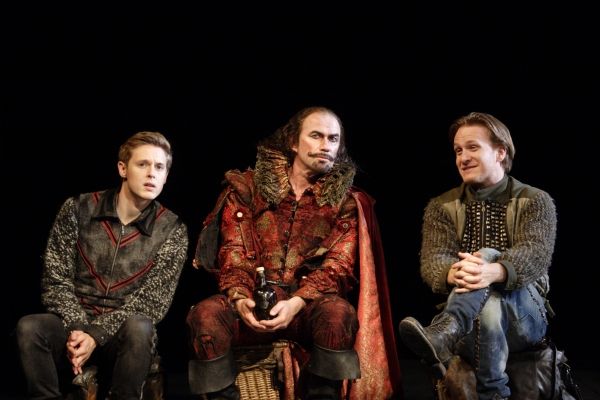
One of the triumphs of the production was Simon Higlett’s set. The light streaming through the floorboards was great and the scene for the boat was brilliantly done, keeping the dark tone and adding character to what had previously been a bare stage. There was some strong casting in choosing Samuel Barnett and Jamie Parker for the lead roles; their work together on the critically acclaimed and ridiculously (but justifiably) successful version of The History Boys gives them a natural familiarity that informs their close friendship on stage. It is certainly very easy to buy into the closeness of their relationship. Parker is the standout performer, launching into long speeches and confusing rationales without hesitation and with believably characterization. His confusion and desperation were believable, much more so than Barnett, who floundered around the stage fulfilling the stereotypes of camp actors. He relied on a set of expressions that became repetitious and although he was funny he didn’t capture the innocence of Rosencrantz in the way that Parker captured the desperation of Guildenstern. He was good but Parker set a higher benchmark.
      
This friendship, which is the core of the play, is somewhat undermined by the gimmicks that are thrown at it, notably the overriding campness of the whole affair. There are obvious homosexual undertones in the text but it feels as though they are trying to force a more overtly physical relationship than there should be and their mannerisms are so camp that they become tiresome, especially when accompanied by the justifiably camp Player. Mellon is played as a dark omen, a shady and untrustworthy character that reminds you of the devil whispering in your ear. The sinister nature of the Player works well and his troupe of players feel suitably exploited and desperate. Mellon himself has a presence that is much needed on stage and he works well with the leading pair, doing well after stepping in for Tim Curry.
      
This is one of my favourite plays, its dynamism and intelligence make it energetic and fun with the philosophical inquiry and the central theme of death give it a gravitas that is enlightening and fascinating. Nunn’s production lacks the cohesion and the energy that gives is that enjoyable edge, instead slathering it with a heavily Becekttian overtone and style at the expense of much of the script. It is very much a reimagining of Waiting for Godot as opposed to an extension of Hamlet or even a hybrid between the two. The text thrives on the combination of Beckett and Shakespeare, which is cut in half by Nunn. Parker is brilliant but he can’t carry the show on his own and although it’s not necessarily a bad show, it is rather underwhelming.


Written by Tom Stoppard; Directed by Trevor Nunn; At the Theatre Royal Haymarket, London; Starring Samuel Barnett, Jamie Parker, Chris Andrew Mellon, Katherine Press, Jack Hawkins; Runs from 16 June 11 - 20 August 11.


John Ord (13/07/2011)