Showing posts with label Duchess Theatre. Show all posts

Sunday, 11 December 2011

The Pitmen Painters ****


The Pitmen Painters tells the story of a group of working-class men from Ashington who created a phenomenon in their lifetime. Starting from a position of complete ignorance with only a desire to learn, they created art that defined their generation. Having originally opened in Newcastle in 2007, the show has enjoyed extended sellout runs at the National (twice) and on Broadway as well as a UK tour before returning to the West End now at the Duchess Theatre. I’m not at all surprised.
      
The first thing to say is that the acting is magnificent throughout. Every character, no matter how small, is fully developed, a dynamic and passionate person built from the foundations up. There is no standout performer, each actor having honed the character through the weeks and months of run that they have behind them and the result is something that you seldom see in theatre – characters that are vibrantly alive. They have within their cohort a history of their own and the longer this group stays together, the more material this bond becomes, the more you can feel a genuine relationship between these men and women on stage.
      
To single anyone out would be to do the others a disservice as each gave performances of the upmost professionalism. There was no moment that any of them weren’t in character and each was endlessly watchable from beginning to end while also being endlessly relatable. There is humour in their mannerisms and their speech but most of all in their relationships with each other and these are all dynamics celebrated by the cast and you can tell that they are all enjoying themselves immensely.
      
This is testament to the power of the script and the confidence of the direction as much as any other factor. Lee Hall and Max Roberts had worked together before teaming up to celebrate the renovation of Roberts’ Live Theatre Company’s theatre in Newcastle. Familiar partners make good partners, it seems, as the result of this collaboration is nothing short of magnificent. It is univocal, has one vision, one direction and the unity between all of these is striking. Every actor, every costume, every line seems perfectly suited to all the others and together it combines to make a whole that is so much greater than the sum of its constituent parts.

      
Hall has some prestigious work behind him, including Billy Elliot and the upcoming film release of War Horse, directed by Steven Spielberg. There is good pedigree behind the script, then, and he has done his research. He also admits in the programme the couple of factual inaccuracies in the script, which commend him even more in my mind. The script has a humanity to it, a simplicity in the companionship these men found with each other and with the paintings that were to become so famous. It is a story that we can all understand and relate to because they are just like us. They don’t understand the big mysteries, they don’t have the power to grasp complex theories and change the course of the world but they have a passion for their art and a burgeoning desire to understand and to learn. We can all relate to that and in places we find ourselves heavily invested in the course the characters’ lives may take. They are us and they make it happen.
      
The set itself is simple and works well, transmuting from lowly hall to museum or country house with ease. The use of projectors is treacherous at best but this production uses them to enhance the production, drawing you in to what the characters are feeling by immersing you in the detail of their art and what they are seeing, thinking and feeling.
      
A touch in the design that I particularly liked was the use of actual paintings. Through the course of the play, these are arranged carefully around the edge of the stage so that at the end of the piece you can look on the stage as a wider exhibition of the work that this unbelievable group of people created from nothing. This exhibits the aim of the show, the power of the direction, in that it tells the story of these men not just through what happened but through the art they created. We can see in front of us the proof of it all and it is immensely inspirational.
      
Above all else, however, the script is an honest celebration of art. Not just in its abstract form apart from the daily business of living but as an extension of ourselves, as a necessary part of our creativity and need to express our experiences to others. What makes this story even more powerful is that it is real. It is not some fantasy dreamed up by a playwright locked in his shed trying to envisage a world in which he can play an important part; it is the story of a group of miners from Ashington who looked to the world for a purpose and who became one of the most important artistic movements in British history. Their work, and all work, is celebrated in this piece of theatre. If you ever have any doubt about the place and need for art in the world, watch this play and find yourself reassured.
      
This production deserves the accolades and the history it has made for itself and I hope it is never too far out of the sights of our community, especially in these dark economic times.


Written by Lee Hall; Directed by Max Roberts; At the Duchess Theatre; Starring Joe Caffrey, Trevor Fox, David Whitaker, Brian Lonsdale, Michael Hodgson, Ian Kelly, Viktoria Kay, Joy Brook; Runs from 5 October 11 - 21 January 12.


John Ord (10/12/2011)

Friday, 1 July 2011

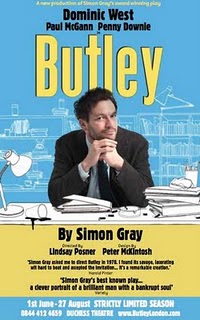
Butley ****


Butley is a play very much written from an insider’s point of view. Simon Gray was himself a lecturer of English and Queen Mary College, London as well as being a heavy smoker, drinker and in possession of a deadly array of words and witticisms. Ben Butley is also all of the above (university unspecified however) and although the autobiographical nature of the play was only confirmed to be ‘up to a point’ the similarity in the characters of the author and the lead makes for an intriguing study of what is an undeniably awful day in the life of Ben Butley. The realism of the character and the situation really strikes very close to home.
      
The homoerotic undertones of the piece are played incredibly well by the cast and you can feel the echo of Gray’s own experiences in the voices of the characters and of course the words they use. Gray himself had developed many close friendships with men over the course of his life but he wasn’t gay, though he was amused by the question and certainly loved the company of men. Butley is of a similar ilk as well, his friendship with his colleague and protégé Joseph being as close to a married life as one is likely to achieve without actually being married, a relationship made even more tense by Joseph’s homosexuality.
      
On this count and on many others Dominic West is in inspirational form, bounding around the stage with the energy of an antelope that’s been caught by a lion and is furiously lashing out in every way it can before it is brought down. People often talk of a ball and the importance of not letting it drop and if there is any performance on the West End at the moment that exemplifies this it is Dominic West’s here. He has clearly put a great deal of effort into creating the character of Ben Butley and reaps the rewards of his endeavours. The realism of the character and the ease with which he speaks the lines is remarkable, with every line, no matter how quick or witty, having a clear point of inception and purpose. There is an awful lot of hectic, chaotic madness but at every point you are aware that there is method in it. The many moments of madness are imbued with such energy that they never cease to be anything other than hilarious, further boosted by West’s talent for comedy. There are also a few moments of sudden transition from humour to seriousness and West handles them well, instantly changing the atmosphere in the room and engaging the audience.
      
He is also a very generous performer, allowing his fellow cast members their moments and giving them as much opportunity as he can, which is a dynamic that works especially well with Martin Hutson’s Joseph. Hutson gives a nervous energy to the show that plays very well with the frantic nature of Butley himself. The relationship between the two is a varied one, with moments of closeness and moments of friction interwoven in a strikingly natural and true-to-life fashion. Hutson himself also gives what is a very strong performance as the younger man desperately trying to find a way to remove himself from his relationship with Butley, his characterisation being second only to West in the show.

The other performance that really stood out for me was from Penny Downie who played Edna Shaft, another lecturer in the university English department that has been struggling with her own issues, such as an unfinished book of literary criticism and a tediously deviant student. Her performance added an air of mystery to the show as she and Butley talk and act as if they have a great deal of history but neither ever mentions explicitly what this history is. Inasmuch as Butley pushes away everyone he cares about, including his students, West and Downie certainly add a powerfully subtle dynamic between the two characters that adds a further layer to what is already an impressive script. The phone calls from the perpetually elusive Dean and the constant interruptions from Downie place Butley and Joe in a wider picture that is well illustrated by Downie’s strong showing.

      
The set design was something else that I thoroughly enjoyed with the difference between the stark left-hand side of the stage that corresponded to Joe and the cluttered and overflowing right-hand side that was clearly Butley’s domain. Lots of the physical gags were very good as well and were only able to be so because of Peter McKintosh’s apt setting.
      
The small size of the roles of the students serve to demonstrate Butley’s prowess in avoiding student contact but they are strong as well, particularly Emma Hiddleston as the keen student who wants her essays read so that she may find her way into teaching herself, suitably put down by Butley, saying that A-Level teachers are like firemen called out to quench a fire long since out.
      
All in all, I think this show was incredibly good fun above all else and a showcase of fantastic talent, particularly from Dominic West as he is allowed to indulge himself in a comedy role, taking to it like someone with prader-willi syndrome to cake and it is delightful to watch. I’d thoroughly recommend giving it a go, especially if you have a prior connection to either university, lecturers, teachers or English.


Written by Simon Gray; Directed by Lindsay Posner; At the Duchess Theatre; Starring Dominic West, Paul McGann, Penny Downie, Amanda Drew, Martin Hutson, Emma Hiddleston, Cal Brigden; Runs from 06 June 11 - 27 August 11.


http://www.butleylondon.com/?gclid=CPTpobi34KkCFUwc4QoduUhSYA


John Ord (28/06/2011)

Saturday, 19 February 2011

Love Story **

As with most reviews, I will preface this by saying that I have neither read the highly successful original novel by Erich Segal, nor seen the even more lucrative Hollywood film and was thus going into the show without expectation or bias, as it appeared most of the audience was.
      
The set was laid out in a sparse fashion; the whole stage was painted and covered in white, including the instruments and props for the band at the back. The lone exception was a black grand piano in the centre, forming a focal point that turned out to not be that much of a focal point in the story at all.
      
The show opened with a musical number that was endearing and almost enchanting but the class of the song was eventually undermined by its reprises and before long I was looking forward to the next song. This turned out to be somewhat unfortunate as the vast majority of the songs sounded more or less the same, so floating in a chorus or two from a different song went almost unnoticed. The whole show sounded the same and the way the songs were staged had very little variation indeed. Having said that, there was a very impressive scene where Michael Xavier and Emma Williams sang a very energetic and fast-paced song while cooking themselves some pasta. Credit given where credit is due.
      
The general acting was rather disappointing as well. With the exception of Peter Polycarpou as the ill-fated Jenny’s father, Phil, there was very little genuine characterisation. Polycarpou brought a depth and a realistic comedy to the show, his character being far more human than the rest of them and, as a result, far easier to connect with. The rest of the cast seem to have picked one element of their character and run with it so that they weren’t so much people as two-dimensional representations. Instead of being a fully developed person, Jenny was an intelligent pianist and Oliver was a confident lawyer. It was frustrating because the scope was there in the script to make a lot of the characters and at various points you could see the actors trying to do so but their efforts were one-off moments and not endorsed by sustained development.
      
The whole show used a very simple style, which would have worked it if was done with greater depth. As it was, the effect this intentionally simple approach turned out to be bland at best. There was very little dynamic and all the dynamics that were in place were either predictably the same or had their foundations in the ether. The whiteness of the set worked well with the props that were wheeled on and off, which I liked, but it didn’t help the severe lack of character to the show.
      
My judgement is that the show rested on its laurels too much, like a general leading a Roman Legion into battle against some disorganised locals it relied too heavily on reputation and took far too many losses in what should have been an easy victory. The fact that it is based on an already incredibly successful franchise and has the talents of Michael Ball on board, albeit as the producer, seemed to be enough to draw audiences into the theatre. Once inside and the curtain up the story was left to do all the work. There was no added colour to it, there was no individuality to it; it was very much the story and not much else. The story is a good one, but even a good story can be told badly and this was in danger of turning into that poor grandparent who falls asleep reading their grandchildren bedtime stories.
      
It was a short show, two hours without an interval and I’m not sure why. Admittedly, more of the same would have sent me to sleep myself but giving the cast more room and more time to develop their characters and the subtle nuances of life that were missing would have been time well spent. The fact that everyone who really enjoyed the show were clearly privy to the story beforehand implies that the show is only worth seeing if you’ve read the book, which I think is indicative of a bad adaptation more than anything else. Lack of awareness of the book a show is based on should not have such a detrimental effect on the ability of the show to stand on its own.
      
The show was sad from the beginning and when she eventually dies at the end you find yourself wondering what she was giving up on as there wasn’t much excitement beforehand. Resigned to lamentation throughout, the show just came across as very one-dimensional, jumping through hoops and ticking boxes as opposed to thinking outside of them and developing something new.
      
I’m not saying that there weren’t good things about the show, there were quite a few things that were done very well, but there wasn’t enough to provide balance or nuance to an underdeveloped show.
      
The one poignant line in the whole show that stood out to me, ‘love’s not what you feel it’s what you do’ was seriously downplayed, coming in at the end of one of the series of lamenting and tedious songs, and almost went unnoticed. I think that most of the audience missed it entirely. Perhaps the moral of this particular love story is that you need to do a whole lot more.


Written by Erich Segal; Adapted by Stephen Clark; Music by Howard Goodall; Directed by Rachel Kavanaugh; at the Duchess Theatre; Starring Emma Williams, Michael Xavier, Peter Polcarpou, Richard Cordery, Jan Hartley, Paul Kemble, Gary Milner; Runs from 27 Nov 10 - 26 Feb 11.


John Ord (18/02/2011)

Saturday, 30 October 2010

Krapp's Last Tape *****

Samuel Beckett was inspired to write Krapp’s Last Tape after hearing Northern Irish actor Patrick Magee reading excerpts from Molloy and From an Abandoned Work on radio. Originally entitled ‘Magee Monologue’ it was premiered in 1958 as a curtain opener for another of his lasting contributions to theatre, Endgame, and starred Patrick Magee. Other notable actors to take on the role before Michael Gambon include John Hurt and playwright Harold Pinter. Michael Gambon here makes a triumphant return to his roots with the Gate Theatre (it was where he made his stage debut before being picked up by Laurence Olivier).
      
Life often fails to live up the expectations and dreams of when we are young and reading an old diary or journal can often be a traumatizing experience; the disparity between what we had hoped would be and what actually has been is often so great that it makes us feel like we missed the opportunities for a better life. This is a harsh realisation and it is the challenge that Krapp, the character of Beckett’s famous monologue, faces throughout the piece.
      
He has settled into the tradition of marking his birthday every year by recording onto reels the events of the year and listening to the ones he has recorded in previous years. He has become a disheveled figure; a ghost of his former self and the production captures this image perfectly. The costume for Krapp is a worn and faded, dirty and unwashed collection of aged clothes, from the assumedly once-white shirt to the scuffed shoes and unkempt hair. He is clearly a man who has long since given up on taking care of himself, wandering off intermittently to a drinks cabinet offstage and feasting on bananas.
      
The set is developed in a minimalist style that is typical of Beckett productions. The single light hanging above the old desk casts a simple picture of the somewhat isolated life of the room’s occupant. The desk also implies a greater time past, being a good quality, large desk but worn and obviously well used.
      
Michael Gambon’s portrayal of Krapp is faultless. When the curtain comes up we see him languishing over the desk and from that moment to the very end he seems as at home in the character as Krapp is at the desk. They are one and the same person. Before too long (though not straight away, of course) he begins to explore his room (though not straying too far from the desk as he runs his thumbnail along the dents along the edges), in search of the pot of gold at the end of the rainbow: a banana. This is a masterful piece of characterisation from both Beckett and Gambon. The inclusion of this image gives Krapp a dimension of animalistic, primitive de-evolved nature and Gambon embraces it. He manages to produce a comedy with the bananas that had me on the verge of laughter that would disturb the near silence of the audience who sat utterly captivated by the power of Gambon’s natural and powerful stage presence.
      
The way he uses the lighting and the props are so comfortable that you easily understand the way the man has deteriorated over the years. Gambon delicately infuses the character with a natural believability, which is remarkable bearing in mind that it’s a script by Samuel Beckett. The subtle nuances regarding his relationship with his former self aren’t prominent but are strong and feature in what is an insightful proportion to the rest of the production. For example, the moment that he fails to remember the meaning of the word ‘viduity’ and has to go to his old and dusty dictionary to remind himself (the state of being a widower or a widow; widowhood) puts him in the very relatable situation of a writer who has lost touch with that which made him unique.
      
The direction is also put together in a very mature and conscious fashion; the simplicity of the script perfectly demonstrated. There is a danger of rushing words or overdoing pauses when you’re faced with a piece of work such as this but in every case the pace and pauses in the script and the actions in the silence weren’t laboured or hurried but kept for as long as was required to elicit a response and then moved on from. Gambon moved at a pace that allowed the full impact of the script to come through and impress on us as an audience.
      
I don’t think I’ve ever seen a piece of theatre as coherent as this and I find this remarkable bearing in mind the demanding nature of the role. Every memory is brought to vivid life, painting colourful pictures of a vibrant life that directly contrasts with the simplicity and blackness of what we can see before us. The passages about his previous girlfriends and lovers, especially the one he returns to again and again with the pair of them sitting in the boat on the lake add so much upon each visit that before long they seem like your memories and you can’t help relating to Krapp in some way or other.
      
This production offers so much in such a short space with such minimalist features that it remains a remarkable piece of work. The person behind me, upon the conclusion of the play, remarked to her partner ‘Is that it?’ There can surely be no better praise for what is a faultless production of a great work of theatre.
     

At the Duchess Theatre, written by Samuel Beckett, directed by Michael Colgan, cast includes Michael Gambon, runs from 15th September – 20th November 2010.


John Ord (27/10/2010)